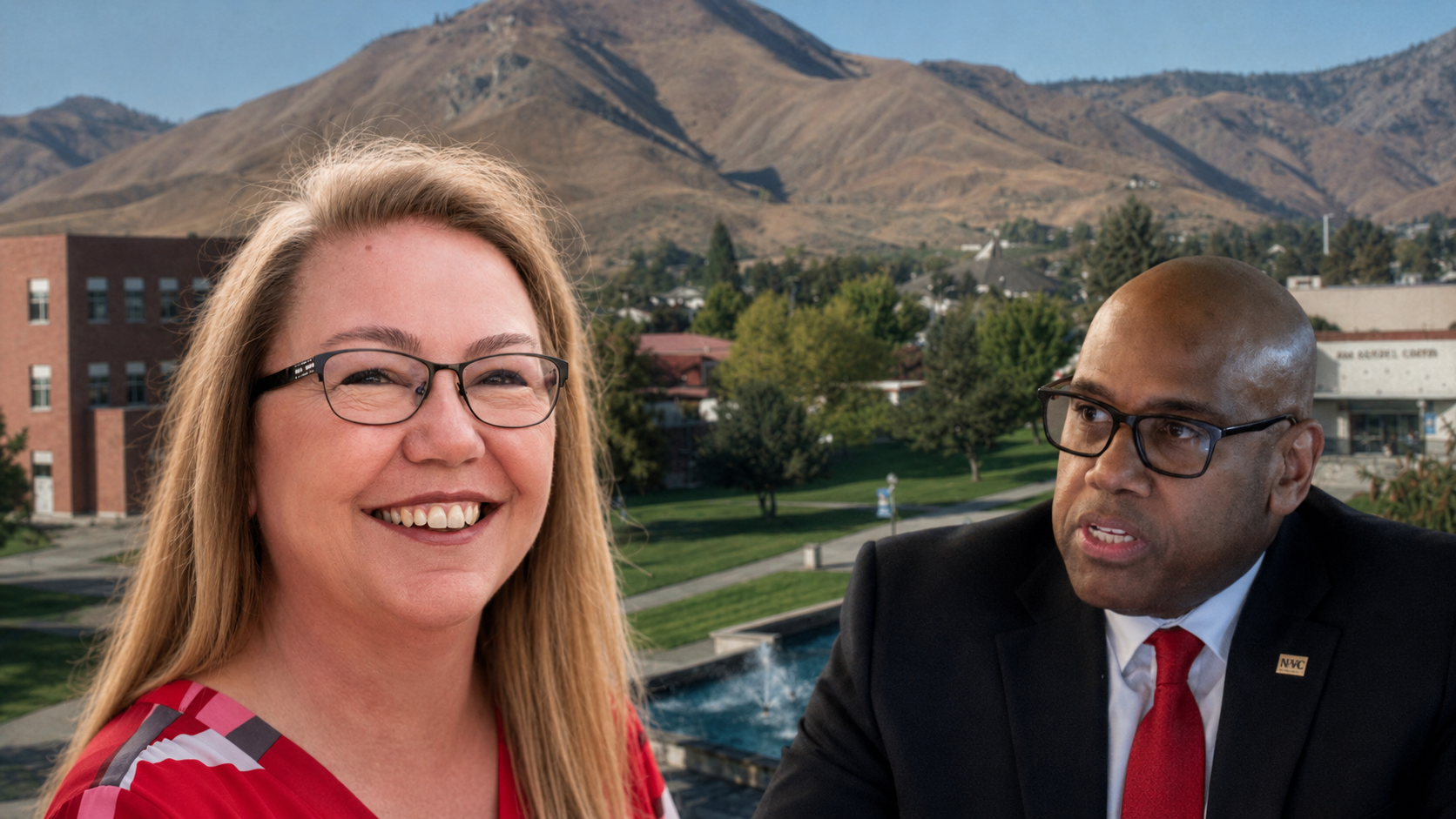
Wenatchee Valley College President Dr. Faimous Harrison has announced that Lisa Harger will step down as vice president of Organizational Culture and Engagement, adding another senior administrator to the growing list of departures from a College already struggling with instability and public distrust.
In an August 25 email to College employees, Harrison said Harger’s final day in her executive position will be September 11. According to the announcement, she will then work remotely in a part-time capacity processing public-record requests until the College fills its vacant public-records position.
Harrison did not explain why Harger is stepping down, whether she resigned voluntarily or whether her departure is connected to the recent public release of her College text messages.
The timing nevertheless deserves public attention.
Harger’s departure comes shortly after the publication of 149 pages of public-record text messages documenting her private communications with senior WVC administrators. Her exit is one more in a continuing sequence of departures accompanying growing scrutiny of the College’s leadership and internal culture.
Those messages revealed an executive culture marked by competing alliances, behind-the-back criticism, selective sharing of colleagues’ communications and widespread frustration with Harrison’s leadership.
The records did not merely document isolated personality conflicts. They exposed a broader culture in which senior administrators privately complained about one another, maintained separate backchannels and expressed little confidence in the president’s ability to confront problems and make decisions.
Now the vice president whose title placed her directly in charge of “Organizational Culture and Engagement” is leaving that position.
A Departure Following Public Scrutiny
Harrison praised Harger in his announcement, crediting her with strengthening Human Resources, rebuilding trust, addressing interpersonal problems and leading the Collaborative Oversight Forum.
He wrote that Harger had helped create “an environment where WVC employees can receive the respect, guidance, and solutions you need to thrive.”
That description stands in sharp contrast to the culture reflected in Harger’s own College text messages.
The records showed Harger privately describing College processes as “complete BS” and saying she was ready to “check out of the shit show.” They showed her criticizing colleagues through third parties, sharing private communications with selected allies and delivering markedly different versions of the same dispute depending on her audience.
She reassured Vice President of Student Affairs Dr. Diana Garza directly, telling her, “You are doing great.” In a separate conversation about Garza, however, Harger wrote:
“It may be obvious but this is ridiculous and pisses me off. Call your employee and handle it Diana!”
When another administrator said Garza “can’t lead,” Harger continued reinforcing the criticism and wrote that Garza “just needs to be directed.”
Harger also privately agreed that a group of employees was a “Mean girl collective” in “full plot mode.” She identified an employee named Robin as “the source of it all,” but later proposed that the College publicly thank Robin when she departed.
These were not the communications of an organization successfully rebuilding trust. They documented a workplace in which public professionalism existed alongside private disparagement and factional loyalty.
The Texts Pointed Back to Harrison
Although Harger’s messages raised serious questions about her own conduct, they also repeatedly pointed toward a larger source of WVC’s dysfunction: Harrison’s leadership.
In private conversations with Vice President of Instruction Dr. Tod Treat, Harger portrayed Harrison as hesitant, isolated and unable to make necessary decisions. The two complained that Harrison made decisions “in a vacuum,” suggested that fear was affecting his leadership and expressed frustration that information did not appear to “sink in” for him.
In one exchange, Harger wrote:
“It’s Faimous and Maria. Even the email response topic was about the 2 of them. But nothing seems to sink in for him.”
Other messages documented administrators attempting to work around Harrison, privately discussing directives they believed he would not issue and debriefing one another about the dysfunction unfolding inside senior leadership meetings.
One administrator described speaking during a leadership discussion “to the point of tears,” only for Harrison to immediately change the subject to finance.
Harger’s conduct should be evaluated on its own merits. But the records show that she was operating inside a culture established and maintained under Harrison’s presidency.
Presidents set expectations. Presidents select senior administrators. Presidents decide whether division, distrust and unprofessional conduct will be confronted or allowed to become part of the institution’s normal operation.
When the same patterns repeatedly appear across an administration, responsibility cannot be confined to whichever administrator leaves next.
Another Departure, but the Same President
Harger’s departure will not by itself repair Wenatchee Valley College.
Nor will changing titles, redistributing duties or appointing additional interim supervisors resolve the underlying problem.
Harrison announced that WVC Controller Nick Crawford will temporarily oversee Human Resources. Harger’s direct reports, Jennifer Hadersberger and Dr. María Morales-Sánchez, will report to Harrison and Treat respectively. The Collaborative Oversight Forum will continue under Marcine Miller, Hadersberger and a faculty co-advisor.
Those arrangements may keep essential work moving, but administrative restructuring is not the same as institutional reform.
WVC has continued to lose senior administrators and employees while Harrison remains in office. Each departure is treated as an individual transition, accompanied by familiar praise and assurances of continuity. The larger pattern, and the leadership environment from which those departures arise, receives far less acknowledgment.
The College community deserves more than another carefully written departure announcement.
It deserves an honest explanation of why so many people have left, why senior administrators privately described the institution in such disturbing terms and why public confidence should remain with the president under whose leadership this culture developed.
The Public Deserves Answers
Harrison’s announcement leaves several important questions unanswered:
- Did Harger voluntarily resign from her vice-presidential position?
- When did she notify the College of her decision?
- Why is she stepping down?
- Did the public release of her College text messages play any role?
- Will she remain a College employee after the public-records transition ends?
- What compensation will she receive while working remotely and part time?
- Has the Board of Trustees examined the culture documented in the messages?
- Does the Board still believe Harrison is the right person to restore trust and stability?
These questions matter because WVC is a public institution funded by taxpayers and governed on behalf of the community. Leadership changes cannot be treated solely as internal personnel matters when they form part of a larger and continuing institutional crisis.
WVC Needs New Leadership
Harger’s departure is another symptom of a College in turmoil. It is not the cure.
The records portray an administration divided by distrust, private alliances, indirect communication and dissatisfaction with the president. Employees described emotional distress. Senior officials privately criticized one another. Important College business unfolded through side conversations and selective backchannels.
This culture did not develop outside Harrison’s administration. It developed within it.
Harrison has had the authority and responsibility to establish expectations, select competent leaders, resolve divisions and maintain public trust. Instead, the instability has continued while additional employees and administrators leave.
Wenatchee Valley College does not simply need another interim appointment or another renamed executive position. It needs a president capable of restoring professionalism, accountability, transparency and confidence in the institution.
It is time for new leadership at Wenatchee Valley College.
About the Records
The text messages discussed in this article were produced by Wenatchee Valley College in response to a request under Washington’s Public Records Act. The complete production contains 149 pages of communications involving Harger and other College personnel.
The records do not reveal every conversation, explain Harger’s internal motives or establish that her departure resulted from their release. The timing alone does not prove causation.
What the records do establish is the language used by senior administrators and the culture reflected in their communications. Readers are encouraged to examine the complete records and reach their own conclusions.
Request for Comment
Harger, Harrison and the Wenatchee Valley College Board of Trustees will be invited to explain the circumstances surrounding Harger’s departure and respond to the issues raised in this article.
Any substantive responses received will be considered for publication and incorporated as appropriate.
Editorial note: This article is based on Harrison’s August 25, 2026 announcement and public records produced by Wenatchee Valley College. The College described Harger as “stepping down” but did not expressly characterize her departure as a resignation. This article does not claim that the release of Harger’s messages caused her departure. Descriptions of the records and their significance reflect the author’s analysis. Anyone discussed in this article is invited to provide clarification, additional context or a response for publication.